
AI is turning you basic
Be careful, or your Wild ‘N Reckless could soon become Pralines ‘N Cream
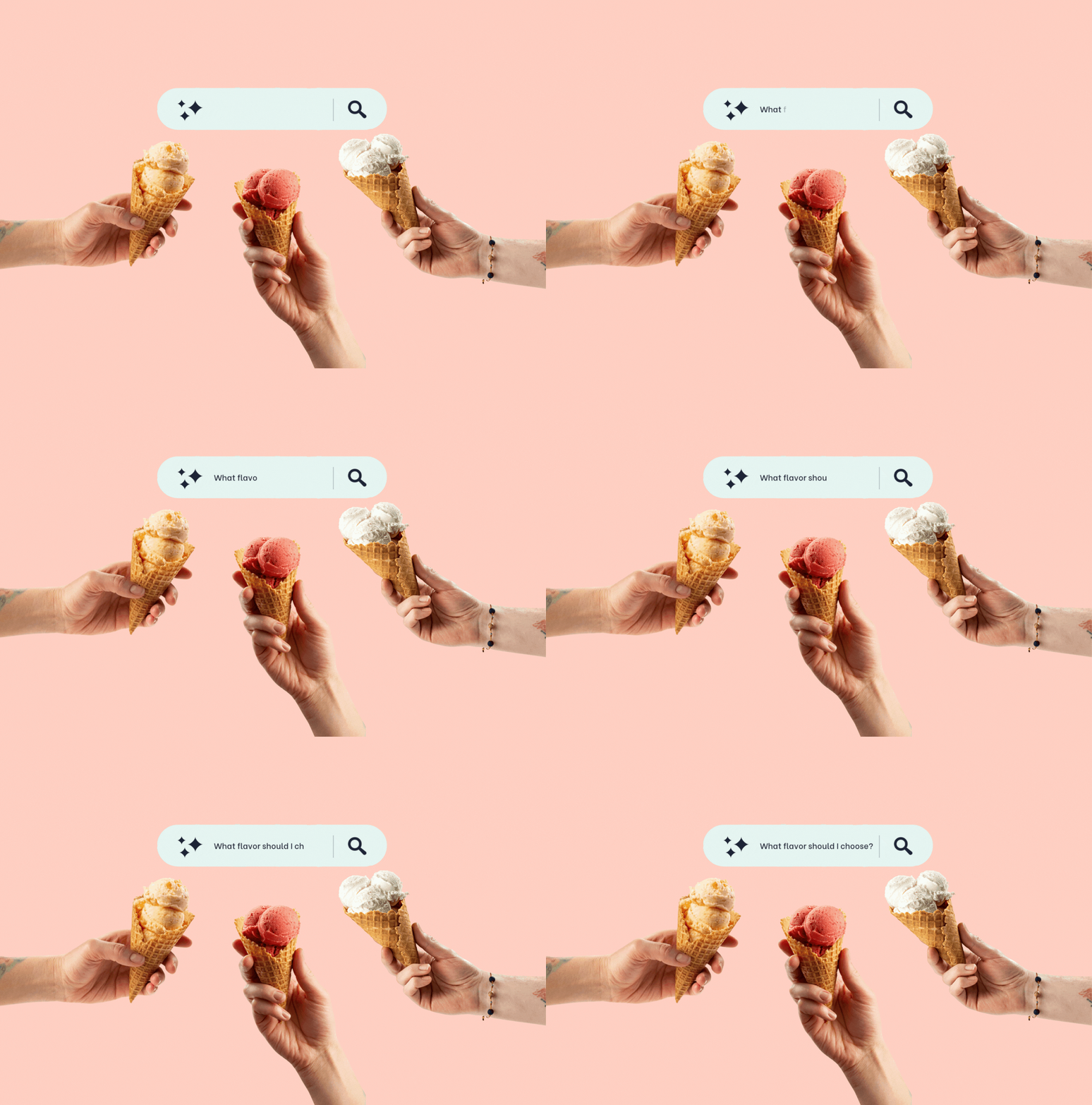 As we have seen in recent months, there are many reasons to be nervous about the growth and impact of artificial intelligence. AI is polarizing, it can spread misinformation and there are many signs that it’s coming for our jobs.
These macro issues are worrisome, but there is a quiet and surprisingly more personal danger: AI makes us boring. Not just collectively, but individually.
Recent studies, including our own, have shown that when we use AI for guidance, our interests become more normative and less diverse. Our creative output becomes less unique. Even our selection of the “most important” scientists, athletes or historical figures becomes the same as everyone else’s.
AI turns the infinite diversity that makes humans special into statistically safe sameness. It strips away the parts of each individual’s identity that make us different and collapses our complexity into a unidimensional, static version of who we are and could be.
AI could revolutionize the future of mental health care, but it comes with big risks
More than 1 in 5 adults in the US experiences mental health problems, yet less than half of those in need receive professional treatment. Worldwide, the gap in supply and demand is so big that for every trained health professional there are over 10,000 potential clients. And it keeps widening year over year. The National Center for Health Workforce Analysis estimates that there will be a need for 60,000 additional mental health professionals by 2036, but predicts that instead, there will be over 10,000 fewer.
To reverse this trend, we need a revolution–a complete overhaul of the way we approach mental health. AI could power that revolution. By democratizing access to care and abandoning one-size-fits-all approaches that merely focus on “fixing” acute mental illness, AI can help us shift toward a more equitable and personalized care that aims to proactively boost psychological well-being.
Thanks to a rapidly evolving technology landscape and recent breakthroughs in Generative AI, this alternate universe isn’t just a pipe dream. In 2023, the global AI mental health market was valued at over USD 921 million and it is projected to grow at a compound annual growth rate of 30.8% until 2032.
The Digital Village: How Algorithms Became Our New Neighbors
I left Vögisheim – the tiny village of 500 people I grew up in – after graduating from high school and today live in New York City where I am a professor at Columbia University.
A difference like day and night. Unlike back home in the village, I barely know my neighbors. And they barely know me. We say hi to each other when we meet in the corridor. But they don’t know what I do for work. They don’t know my friends and family. And they certainly don’t know anything about my deepest fears or aspirations.
But as it turns out, you don’t have to live in a small, rural community to have someone watch and influence every step you take and choice you make. That’s because we all have digital neighbors.
Other Featured Press
The Dangers of AI Personalization | Time
Cette technologie qui nous épie | La Presse
Protect Yourself | Association for Talent Development
Business books: what to read this month | Financial Times
The Case for Privacy by Design | Builtin
The Nosy Neighbor is Your Web Browser: How Psychology Went Digital | Next Big Idea Plan
Elon Musk, Mark Zuckerberg, & the Exacerbation of Fake News | Real Clear Markets
Fake news is driving us apart amid disaster — but slanted news is slowly drowning our democracy | Salon
A review of Mindmasters by Sandra Matz | Sri Lanka Guardian
An Excerpt from Mindmasters | Porchlight
Book Brief: Mindmasters | Clear Purpose
Data crumbs and sitting ducks | Science
Q&A with Sandra Matz | Rotman
On Our Shelves | Columbia Business School Magazine
Rapid spread of election disinformation stokes alarm | The Hill
The Next Big Idea Club’s January 2025 Must-Read Books | Next Big Idea Club
I Took a Decision Holiday and put A.I. in Charge of My Life | The New York Times
Mindmasters: The Data-Driven Science of Predicting and Changing Human Behavior | Publishers Weekly
 Sandra Matz