
Mindmasters
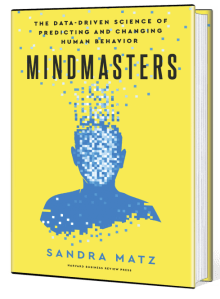 There are more digital pieces of data than stars in the universe. This data helps us monitor our planet, decipher our genetic code, and take a deep dive into our psychology.
As algorithms become increasingly adept at accessing our minds, they also become more and more powerful at controlling it – enticing us to buy a certain product or vote for a certain political candidate.
In Mindmasters, Columbia professor Sandra Matz offers a fascinating insider perspective on the art and data-driven science of psychological targeting. Filled with Ted-Talk-like explanations and real-life examples from Matz’s research and consulting work, Mindmasters reveals how Big Data offers insights into the most intimate aspects of our psyche and how these insights empower external influence over the choices we make.
Some say this technological trend is no big deal. Others consider it one of the greatest threats to humanity. But what if the truth is more nuanced and mind-bending than that? With passion and clear-eyed precision, Matz discusses how psychological targeting can be creepy, manipulative and downright harmful—with scandals like Cambridge Analytica being merely the tip of the iceberg—but also holds enormous potential to help us live healthier and happier lives.
Turning psychological targeting into a catalyst for social good will require redesigning the data game. Mindmasters shows us how.
Mindmasters is a riveting look at what our digital footprints reveal about us, how they’re being used—for good and for ill—and how we can redesign the data game to gain more control and power over the data that define us.
Learn more about the book at mindmasters.ai.
The Psychology of Technology: Social Science Research in the Age of Big Data

Rapid advances in information technology have profound implications for human interaction, mental health, and the field of psychology itself.
Digital technologies increasingly impact nearly every aspect of our lives, affecting not only our well-being but also changing the way we work, design policies, define morality, and even the way we think.
This book examines research from different subdisciplines across psychology to address the ways in which technology and Big Data provide a unique window into human cognition and behavior.
Every interaction with smartphones, computers, and tablets leaves a trace, a digital footprint that offers fresh insights to psychologists studying the new frontiers of human behavior. At the same time, the use of public information provided by private citizens—social media postings, digital networks, datasets, and internet preferences—requires careful attention to ethical considerations.
An especially timely book in light of the COVID-19 pandemic, when so many people were forced to live online like never before. Many of the changes, for individuals, workplaces, and societies, will be long-lasting.
 Sandra Matz